Artificial intelligence is transforming industries by helping businesses automate tasks, improve decision-making, and create intelligent applications. Behind every successful vision-based AI system is computer vision data annotation, which enables models to recognize and understand visual information accurately. From healthcare and retail to manufacturing and autonomous vehicles, properly labeled images and videos improve AI performance and reliability.
Macgence provides high-quality annotation solutions that support AI development with accurate, scalable, and secure data labeling services. Well-annotated datasets help machine learning models identify objects, detect patterns, and perform complex visual tasks with greater precision.
Applications Across Industries
Businesses across many industries rely on accurate visual datasets to develop intelligent AI systems.
1.Healthcare
Medical imaging solutions analyze annotated X-rays, MRI scans, CT scans, and pathology images to assist doctors in diagnosis.
2.Automotive
Self-driving technology depends on computer vision data annotation to identify vehicles, pedestrians, road signs, traffic signals, and lane markings.
3.Retail
Retail companies use AI for product recognition, inventory management, visual search, customer analytics, and automated checkout systems.
4.Manufacturing
Factories use image-based AI for quality inspection, defect detection, production monitoring, and automated sorting.
5.Security
Surveillance systems analyze annotated video footage to detect unusual activities and improve public safety.
Importance of Quality Data
The success of an AI model depends heavily on the quality of its training data. Reliable computer vision data annotation creates consistent datasets that improve learning and help models perform better in production environments.
High-quality annotations reduce bias, improve detection accuracy, and make AI systems more dependable across different use cases. Consistency throughout the dataset also supports faster model development and better evaluation results.
Understanding the Process
Computer vision data annotation is the process of labeling images and videos so AI models can identify objects, people, scenes, and important visual elements. Human annotators carefully mark different features using specialized tools to create structured datasets for machine learning.
Accurate labeling allows AI systems to recognize visual patterns more effectively, reducing errors and improving prediction accuracy across real-world applications.
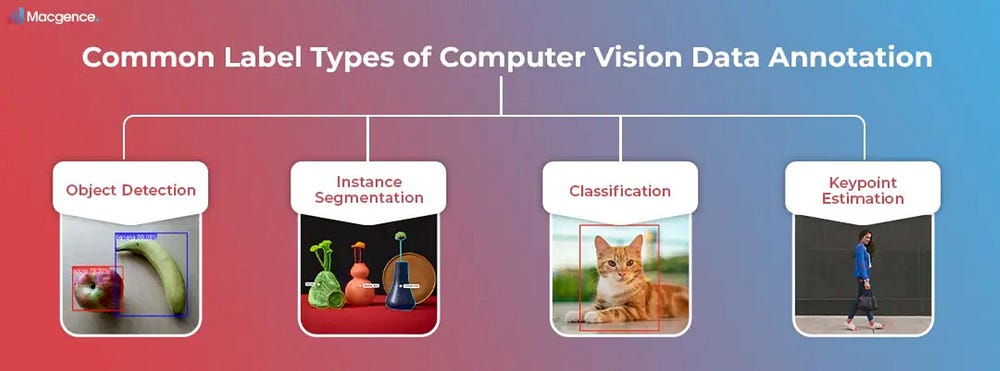
Common Annotation Techniques
Different AI projects require different labeling methods based on their objectives and dataset requirements.
1.Bounding Box Labeling
Bounding boxes surround objects with rectangular shapes, making them suitable for object detection tasks such as traffic monitoring, retail analytics, and security systems.
2.Polygon Labeling
Polygon labeling creates precise outlines around irregular objects, allowing AI models to learn detailed object boundaries.
3.Semantic Segmentation
This technique assigns every pixel in an image to a specific category, helping AI understand complete scenes with greater detail.
4.Instance Segmentation
Instance segmentation separates multiple objects belonging to the same category, allowing each object to be identified individually.
5.Keypoint Labeling
Keypoint annotation marks important landmarks such as facial features, body joints, or hand positions for pose estimation and facial recognition.
6.Polyline Labeling
Polyline annotation traces roads, lanes, pipelines, railway tracks, and other linear structures for navigation and mapping applications.
Professional Annotation Services
Organizations developing AI applications benefit from experienced annotation partners that maintain high-quality standards throughout every project.
Professional computer vision data annotation services include image labeling, video annotation, semantic segmentation, polygon annotation, object tracking, keypoint labeling, dataset validation, and quality assurance. Multi-stage review processes improve consistency and reduce labeling errors.
Scalable annotation teams also support projects ranging from thousands to millions of images while maintaining accuracy and secure data handling.
Selecting the Right Service Provider
Choosing the right annotation partner has a direct impact on AI model performance. Experienced providers follow standardized workflows, maintain strict quality checks, and deliver consistent datasets within project timelines.
Organizations should evaluate industry expertise, annotation capabilities, data security measures, quality assurance processes, turnaround time, and scalability before selecting a service provider.
Reliable teams also offer customized workflows that match specific project requirements and support long-term AI development goals.
Future Trends
AI-assisted labeling tools continue improving productivity, while human expertise remains essential for maintaining precision, handling complex scenarios, and validating dataset quality. Combining automation with expert review creates stronger datasets for future AI applications.
Artificial intelligence continues expanding into healthcare, robotics, autonomous systems, smart cities, manufacturing, and many other sectors. This growth increases the demand for high-quality computer vision data annotation across diverse industries.
Frequently Asked Questions
Q1. What is image labeling?
Answer: It is the process of labeling images so AI models can recognize visual objects accurately.
Q2. Why is image labeling important?
Answer: It improves AI accuracy by providing reliable training data.
Q3. Which industries use image labeling?
Answer: Healthcare, automotive, retail, manufacturing, agriculture, and security.
Q4. What are the common labeling methods?
Answer: Bounding boxes, polygons, segmentation, keypoints, and polylines.
Q5. Can annotation services handle large datasets?
Answer: Yes, professional teams can manage projects of any size while maintaining quality.
Q6. How do I choose the right service provider?
Answer: Look for experience, quality assurance, scalability, and strong data security.
Conclusion
High-quality computer vision data annotation remains the foundation of successful AI systems because accurate datasets lead to better model performance, improved reliability, and faster development. Businesses across industries continue investing in precise annotation to build smarter and more dependable AI solutions. Partnering with an experienced provider like Macgence helps organizations create scalable, consistent, and secure datasets that support long-term AI innovation and business growth.
For more information click here — https://macgence.com/blog/computer-vision-data-annotation/